
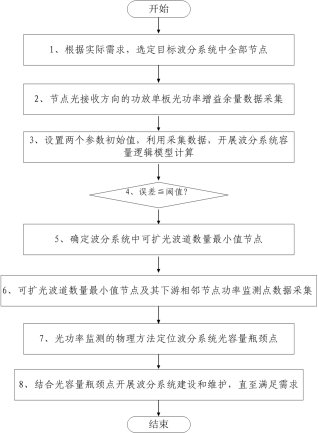
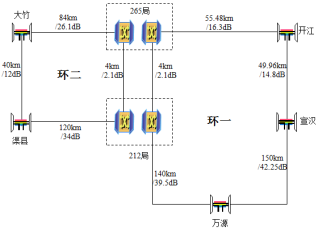
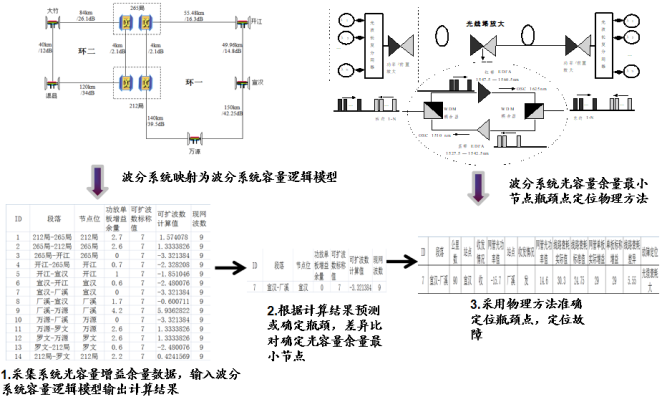
In the current digital health service technology architecture, a dedicated network operates on wavelength division systems built with OTN (Optical Transport Network) and related technologies. However, OTN-based wavelength division optical networks inherently suffer from limitations, as they can only perform hardware monitoring of service signals and detect deviations from standard optical power levels.Facing the construction and development trend of digital health transmission system,to address the current lack of system-level bottleneck detection capabilities in wavelength division systems, we introduce intelligent features such as characteristic data analysis and model-based evaluation, enabling dynamic perception of system bottlenecks. Starting from mathematical models that correlate optical capacity with carrier number capacity, we developed a bottleneck detection method for wavelength division systems. This approach requires only the collection of one type of system parameter and utilizes software tools for carrier beam data analysis to monitor system bottlenecks, perform diagnostics, and locate fault segments. During practical implementation, this method remains compatible with traditional wavelength division troubleshooting techniques, a technical trial run was conducted on the city's digital health business dedicated networkachieving Supports remote medical consultation and diagnostic testing services for municipal districts and five county-level regions, cost-effective and accurate identification of bottleneck points while significantly enhancing the security of digital health information transmission.
| Published in | Science Discovery (Volume 13, Issue 6) |
| DOI | 10.11648/j.sd.20251306.11 |
| Page(s) | 108-112 |
| Creative Commons |
This is an Open Access article, distributed under the terms of the Creative Commons Attribution 4.0 International License (http://creativecommons.org/licenses/by/4.0/), which permits unrestricted use, distribution and reproduction in any medium or format, provided the original work is properly cited. |
| Copyright |
Copyright © The Author(s), 2025. Published by Science Publishing Group |
Focusing Systems, Bottlenecks, Judging, Optical Capacity, Beam
 ,其中En为波分系统总容量光功率,Eε为波分系统总容量冗余光功率,
  为波分系统总容量中可扩容部分光功率,
  为波分系统总容量中已使用的光功率。
  其中
其中  为光功率,N为光承载波数。
  。
。  、
、  初始值,将7个节点采集数据
  代入光波道数逻辑模型得出Xn,其中Zn值可以从网管直接获取,ε值按通信行业标准取1至2
| [1] | 钟昌锦, 刘斌, 付益等. 密集波分复用(DWDM)技术实现原理分析 [J]. 广东通信技术, 2021, 41(04): 66-68. |
| [2] | 万成超, 蒲涛, 胡友鹏. DWDM设备维护中的光功率调整原则 [J]. 军事通信技术, 2012(04): 78-81. |
| [3] | 陆源, 刘勇. 高速波分系统的OSNR测试研究 [J]. 山东通信技术. 2023, 43(02): 17-18. |
| [4] | 陈翠芬. 高速波分系统的OSNR测试研究 [J]. 通信与信息技术, 2023(04): 31-32. |
| [5] | 项国刚. 采用光功率监测法监测光纤劣化的可行性 [J]. 四川通信技术, 1997(06): 25-33. |
| [6] | 杨东, 轩克辉. 光纤损耗的测试 [J]. 山东轻工业学院学报(自然科学版), 2011: 74-76. |
| [7] | 黄祥本, 梁有程. WDM传输系统光功率调试分析 [J]. 长沙通信职业技术学院学报, 2012(02): 21-24. |
| [8] | 胡海良. 低损耗光纤在中电信现网的应用 [J]. 数字通信世界, 2017(11): 162. |
| [9] | 刘琳, 赵长有. 光功率测试单元系统设计 [J]. 世界电子元器件, 2003(01): 53-54. |
| [10] | 康世群, 吴亚楠. 通信传输网络故障压降的策略分析 [J]. 数据通信, 2025(04): 50-51. |
| [11] | 幺宏伟. 光网络波分设备光功率异常和误码故障处理探讨 [J]. 中国新通信, 2021(02): 125-126. |
| [12] | 贺秀娟, 徐加彦. 数字接收分系统故障检测软件开放式架构 [J]. 电子信息对抗技术, 2022, 37(04): 115-116. |
| [13] | 贺金花. 100G OTN技术在骨干网传输系统中的应用 [D]. 南京理工大学, 2020(02): 33-38. |
| [14] | 乐孜纯, 张明, 全必胜. 光网络实用组网技术 [M]. 西安电子科技大学出版社, 2008(07): 16-18. |
| [15] | 闫斐. OTN光传送网波分系统中误码分析及研究 [J]. 广播电视网络, 2022, 29(02): 78-80. |
APA Style
Yan, T., Jiang, L. Y., Ke, G. (2025). Bottleneck Determination Technology and Application of Wavelength Division System for Signal Transmission in Digital Health Business. Science Discovery, 13(6), 108-112. https://doi.org/10.11648/j.sd.20251306.11
ACS Style
Yan, T.; Jiang, L. Y.; Ke, G. Bottleneck Determination Technology and Application of Wavelength Division System for Signal Transmission in Digital Health Business. Sci. Discov. 2025, 13(6), 108-112. doi: 10.11648/j.sd.20251306.11
AMA Style
Yan T, Jiang LY, Ke G. Bottleneck Determination Technology and Application of Wavelength Division System for Signal Transmission in Digital Health Business. Sci Discov. 2025;13(6):108-112. doi: 10.11648/j.sd.20251306.11
@article{10.11648/j.sd.20251306.11,
  author = {Tang Yan and Liu Yong Jiang and Gong Ke},
  title = {Bottleneck Determination Technology and Application of Wavelength Division System for Signal Transmission in Digital Health Business
},
  journal = {Science Discovery},
  volume = {13},
  number = {6},
  pages = {108-112},
  doi = {10.11648/j.sd.20251306.11},
  url = {https://doi.org/10.11648/j.sd.20251306.11},
  eprint = {https://article.sciencepublishinggroup.com/pdf/10.11648.j.sd.20251306.11},
  abstract = {In the current digital health service technology architecture, a dedicated network operates on wavelength division systems built with OTN (Optical Transport Network) and related technologies. However, OTN-based wavelength division optical networks inherently suffer from limitations, as they can only perform hardware monitoring of service signals and detect deviations from standard optical power levels.Facing the construction and development trend of digital health transmission system,to address the current lack of system-level bottleneck detection capabilities in wavelength division systems, we introduce intelligent features such as characteristic data analysis and model-based evaluation, enabling dynamic perception of system bottlenecks. Starting from mathematical models that correlate optical capacity with carrier number capacity, we developed a bottleneck detection method for wavelength division systems. This approach requires only the collection of one type of system parameter and utilizes software tools for carrier beam data analysis to monitor system bottlenecks, perform diagnostics, and locate fault segments. During practical implementation, this method remains compatible with traditional wavelength division troubleshooting techniques, a technical trial run was conducted on the city's digital health business dedicated networkachieving Supports remote medical consultation and diagnostic testing services for municipal districts and five county-level regions, cost-effective and accurate identification of bottleneck points while significantly enhancing the security of digital health information transmission.
},
 year = {2025}
}
TY  - JOUR
T1  - Bottleneck Determination Technology and Application of Wavelength Division System for Signal Transmission in Digital Health Business

AU  - Tang Yan
AU  - Liu Yong Jiang
AU  - Gong Ke
Y1  - 2025/11/22
PY  - 2025
N1  - https://doi.org/10.11648/j.sd.20251306.11
DO  - 10.11648/j.sd.20251306.11
T2  - Science Discovery
JF  - Science Discovery
JO  - Science Discovery
SP  - 108
EP  - 112
PB  - Science Publishing Group
SN  - 2331-0650
UR  - https://doi.org/10.11648/j.sd.20251306.11
AB  - In the current digital health service technology architecture, a dedicated network operates on wavelength division systems built with OTN (Optical Transport Network) and related technologies. However, OTN-based wavelength division optical networks inherently suffer from limitations, as they can only perform hardware monitoring of service signals and detect deviations from standard optical power levels.Facing the construction and development trend of digital health transmission system,to address the current lack of system-level bottleneck detection capabilities in wavelength division systems, we introduce intelligent features such as characteristic data analysis and model-based evaluation, enabling dynamic perception of system bottlenecks. Starting from mathematical models that correlate optical capacity with carrier number capacity, we developed a bottleneck detection method for wavelength division systems. This approach requires only the collection of one type of system parameter and utilizes software tools for carrier beam data analysis to monitor system bottlenecks, perform diagnostics, and locate fault segments. During practical implementation, this method remains compatible with traditional wavelength division troubleshooting techniques, a technical trial run was conducted on the city's digital health business dedicated networkachieving Supports remote medical consultation and diagnostic testing services for municipal districts and five county-level regions, cost-effective and accurate identification of bottleneck points while significantly enhancing the security of digital health information transmission.

VL  - 13
IS  - 6
ER  -
Information Technology Section, Dazhou Health and Family Planning Information Center, Dazhou, China
Information Center, Dazhou Third People's Hospital, Dazhou, China
Information Center, Dazhou First People's Hospital, Dazhou, China

Information



 Share This Article
 Twitter
 Linked In
 Facebook
 Copy
Copy Download