
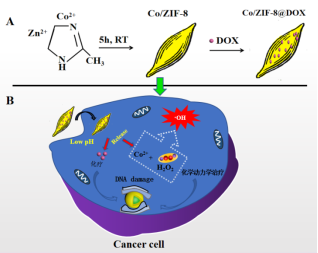
To address the inherent limitations of single-mode cancer therapy—such as low efficacy, high susceptibility to drug resistance, and the inability to completely eliminate residual tumor cells—this study innovatively adopted an ion-doping strategy to successfully fabricate Co2+-doped ZIF-8 small nanocrystal carriers under mild room temperature conditions, avoiding harsh reaction environments that may impair material performance. Endowed with a unique porous structure and large specific surface area, the as-prepared carrier exhibited excellent drug-loading performance, achieving a maximum loading capacity of 84.4% for the widely used chemotherapeutic agent doxorubicin (DOX). Thus, a synergistic nanotherapeutic system (CFD) integrating chemodynamic therapy and chemotherapy was rationally constructed to leverage the complementary advantages of both modalities. In vitro cell experimental results demonstrated that after 24 hours of incubation, the chemo/chemodynamic synergistic nanosystem exerted a lethality rate of up to 87.1% against HeLa cervical cancer cells, which was significantly superior to that of either monotherapy (single chemotherapy or chemodynamic therapy alone). This finding fully confirms that the CFD nanotherapeutic system possesses potent in vitro anticancer activity, as it can synergistically leverage the merits of both treatment modalities to enhance therapeutic efficacy and effectively overcome the limitations of single-mode therapy. Collectively, this work provides a reliable experimental foundation and promising application prospects for subsequent in-depth in vivo tumor therapy research and potential clinical translation.
| Published in | Science Discovery (Volume 13, Issue 6) |
| DOI | 10.11648/j.sd.20251306.14 |
| Page(s) | 125-130 |
| Creative Commons |
This is an Open Access article, distributed under the terms of the Creative Commons Attribution 4.0 International License (http://creativecommons.org/licenses/by/4.0/), which permits unrestricted use, distribution and reproduction in any medium or format, provided the original work is properly cited. |
| Copyright |
Copyright © The Author(s), 2025. Published by Science Publishing Group |
Co/ZIF-8 Nanomaterials, DOX, Anti-cancer

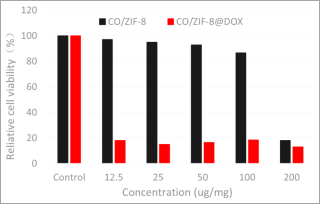
Co/ZIF - 8组 | OD值 | 平均值 | |||||
200 | 0.35 | 0.263 | 0.341 | 0.353 | 0.412 | 0.322 | —— |
100 | 1.426 | 1.445 | 1.432 | 1.451 | 1.472 | 1.468 | —— |
50 | 1.515 | 1.523 | 1.567 | 1.548 | 1.565 | 1.578 | —— |
25 | 1.656 | 1.693 | 1.525 | 1.537 | 1.623 | 1.478 | —— |
12.5 | 1.605 | 1.581 | 1.713 | 1.658 | 1.594 | 1.568 | —— |
Control | 1.598 | 1.595 | 1.727 | 1.693 | 1.658 | 1.732 | 1.667 |
空白对照 | 0.052 | 0.052 | 0.051 | 0.051 | 0.052 | 0.051 | 0.052 |
Co/ZIF-8@DOX组 | OD值 | 平均值 | |||||
200 100 | 0.275 | 0.282 | 0.312 | 0.225 | 0.232 | 0.218 | —— |
0.359 | 0.363 | 0.332 | 0.347 | 0.351 | 0.320 | —— | |
50 | 0.342 | 0.343 | 0.276 | 0.324 | 0.316 | 0.274 | —— |
25 | 0.314 | 0.311 | 0.257 | 0.299 | 0.292 | 0.254 | —— |
12.5 | 0.377 | 0.377 | 0.300 | 0.350 | 0.332 | 0.294 | —— |
Control | 1.663 | 1.607 | 1.635 | 1.663 | 1.656 | 1.671 | 1.649 |
空白对照 | 0.050 | 0.051 | 0.052 | 0.051 | 0.051 | 0.051 | 0.051 |
| [1] | 滕熠,张晓丹,夏昌发,等.中国与全球癌症发病、死亡和患病对比及其预测分析:GLOBOCAN 2022数据解读[J].中华肿瘤防治杂志, 2024, 31(23): 1413-1420. |
| [2] | 王峻. 纳米囊泡药物载体系统的构建及其在结直肠癌靶向治疗的应用研究[D]. 长春工业大学, 2025. |
| [3] | 张松涛,林子夏,周俊,等. 电子显微镜在化学化工类本科教学中的探索 [J]. 当代化工研究, 2025, (04): 136-138. |
| [4] | 周强. 基于生物质前驱体制备碳纳米复合材料及其电化学性能研究[D]. 湖南大学, 2019. |
| [5] | 张善纯,程祥玉,宋蓉,等. 钛表面ZIF-L涂层的构建及细胞毒性检测 [J]. 哈尔滨医科大学学报, 2024, 58 (01): 100-104. |
| [6] | 龚姗,白波,李苗,等. 细胞分裂周期相关蛋白3在卵巢癌发生发展中的作用及对化疗敏感性影响的机制研究 [J]. 中国优生与遗传杂志, 2025, 33 (03): 513-524. |
| [7] | 张俊雄,张宇慧,沈静. ZIF-8及复合材料的合成与研究进展 [J]. 辽宁化工, 2025, 54 (02): 283-287. |
| [8] | 殷逸梅. 基于分子印迹的新型智能生物材料表面的设计与应用研究[D]. 江苏科技大学, 2021. |
| [9] | 李晓静. 基于菁染料光敏感纳米粒子的构建及在肿瘤治疗中的应用[D]. 大连理工大学, 2021. |
| [10] | 楚惠元.增强化学动力学疗法的多功能纳米治疗体系的构建及体外治疗性能评价 [D]. 西北大学, 2022. |
| [11] | 黄可榆. 负载Nisin的果胶微胶囊的制备及其对芒果保鲜效果的研究 [D]. 广西大学, 2022. |
| [12] | 栾小芳. BODIPY型次氯酸荧光探针的设计合成及性质研究 [D]. 烟台大学, 2024. |
| [13] | 马英中. 吻合钉用高强韧可控降解Mg-Zn-Ca-X的合金化规律与组织性能研究 [D]. 北京科技大学, 2022. |
| [14] | 孙琳琳. 玉米中黄曲霉毒素B1的酶联和比率荧光免疫检测方法研究 [D]. 长江大学, 2024. |
| [15] | 昌天鹤, 全姬善. pH敏感脂质体在肿瘤治疗领域的研究进展 [J]. 河南大学学报(医学版), 2024, 43 (03): 157-161. |
APA Style
Yu-fei, C., Bo-hua, F., Hui-yuan, C. (2025). Preparation of Novel Co/ZIF-8 Nanocomposites and Evaluation of Their Anticancer Cell Performance in Vitro. Science Discovery, 13(6), 125-130. https://doi.org/10.11648/j.sd.20251306.14
ACS Style
Yu-fei, C.; Bo-hua, F.; Hui-yuan, C. Preparation of Novel Co/ZIF-8 Nanocomposites and Evaluation of Their Anticancer Cell Performance in Vitro. Sci. Discov. 2025, 13(6), 125-130. doi: 10.11648/j.sd.20251306.14
@article{10.11648/j.sd.20251306.14,
  author = {Chen Yu-fei and Fan Bo-hua and Chu Hui-yuan},
  title = {Preparation of Novel Co/ZIF-8 Nanocomposites and Evaluation of Their Anticancer Cell Performance in Vitro
},
  journal = {Science Discovery},
  volume = {13},
  number = {6},
  pages = {125-130},
  doi = {10.11648/j.sd.20251306.14},
  url = {https://doi.org/10.11648/j.sd.20251306.14},
  eprint = {https://article.sciencepublishinggroup.com/pdf/10.11648.j.sd.20251306.14},
  abstract = {To address the inherent limitations of single-mode cancer therapy—such as low efficacy, high susceptibility to drug resistance, and the inability to completely eliminate residual tumor cells—this study innovatively adopted an ion-doping strategy to successfully fabricate Co2+-doped ZIF-8 small nanocrystal carriers under mild room temperature conditions, avoiding harsh reaction environments that may impair material performance. Endowed with a unique porous structure and large specific surface area, the as-prepared carrier exhibited excellent drug-loading performance, achieving a maximum loading capacity of 84.4% for the widely used chemotherapeutic agent doxorubicin (DOX). Thus, a synergistic nanotherapeutic system (CFD) integrating chemodynamic therapy and chemotherapy was rationally constructed to leverage the complementary advantages of both modalities. In vitro cell experimental results demonstrated that after 24 hours of incubation, the chemo/chemodynamic synergistic nanosystem exerted a lethality rate of up to 87.1% against HeLa cervical cancer cells, which was significantly superior to that of either monotherapy (single chemotherapy or chemodynamic therapy alone). This finding fully confirms that the CFD nanotherapeutic system possesses potent in vitro anticancer activity, as it can synergistically leverage the merits of both treatment modalities to enhance therapeutic efficacy and effectively overcome the limitations of single-mode therapy. Collectively, this work provides a reliable experimental foundation and promising application prospects for subsequent in-depth in vivo tumor therapy research and potential clinical translation.
},
 year = {2025}
}
TY  - JOUR
T1  - Preparation of Novel Co/ZIF-8 Nanocomposites and Evaluation of Their Anticancer Cell Performance in Vitro

AU  - Chen Yu-fei
AU  - Fan Bo-hua
AU  - Chu Hui-yuan
Y1  - 2025/12/10
PY  - 2025
N1  - https://doi.org/10.11648/j.sd.20251306.14
DO  - 10.11648/j.sd.20251306.14
T2  - Science Discovery
JF  - Science Discovery
JO  - Science Discovery
SP  - 125
EP  - 130
PB  - Science Publishing Group
SN  - 2331-0650
UR  - https://doi.org/10.11648/j.sd.20251306.14
AB  - To address the inherent limitations of single-mode cancer therapy—such as low efficacy, high susceptibility to drug resistance, and the inability to completely eliminate residual tumor cells—this study innovatively adopted an ion-doping strategy to successfully fabricate Co2+-doped ZIF-8 small nanocrystal carriers under mild room temperature conditions, avoiding harsh reaction environments that may impair material performance. Endowed with a unique porous structure and large specific surface area, the as-prepared carrier exhibited excellent drug-loading performance, achieving a maximum loading capacity of 84.4% for the widely used chemotherapeutic agent doxorubicin (DOX). Thus, a synergistic nanotherapeutic system (CFD) integrating chemodynamic therapy and chemotherapy was rationally constructed to leverage the complementary advantages of both modalities. In vitro cell experimental results demonstrated that after 24 hours of incubation, the chemo/chemodynamic synergistic nanosystem exerted a lethality rate of up to 87.1% against HeLa cervical cancer cells, which was significantly superior to that of either monotherapy (single chemotherapy or chemodynamic therapy alone). This finding fully confirms that the CFD nanotherapeutic system possesses potent in vitro anticancer activity, as it can synergistically leverage the merits of both treatment modalities to enhance therapeutic efficacy and effectively overcome the limitations of single-mode therapy. Collectively, this work provides a reliable experimental foundation and promising application prospects for subsequent in-depth in vivo tumor therapy research and potential clinical translation.

VL  - 13
IS  - 6
ER  -
Department of Chemical and Environmental Engineering,Hetao University, Bayannur, China
Biography: 陈宇菲,女,2002年出生,学士,研究方向为纳米材料的制备及应用研究。

Department of Chemical and Environmental Engineering,Hetao University, Bayannur, China
Department of Chemical and Environmental Engineering,Hetao University, Bayannur, China
Biography: 楚惠元,女,1982年出生,博士,毕业于西北大学,河套学院讲师,研究方向为纳米材料的制备及应用研究。


Information



 Share This Article
 Twitter
 Linked In
 Facebook
 Copy
Copy Download